Course summary field: What fractions really mean, finding equivalent fractions, and reducing to lowest terms.
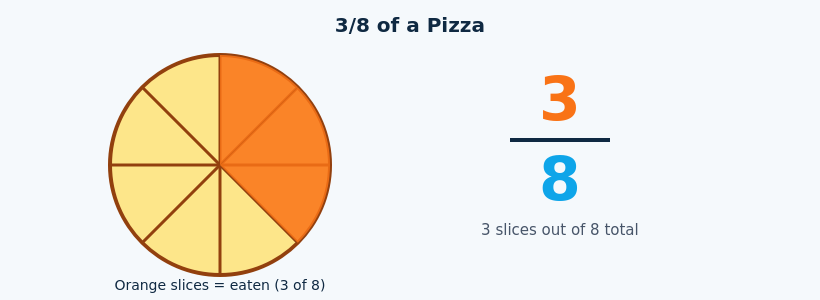
A fraction is just a way to describe part of a whole. Imagine a pizza cut into 8 equal slices. If you eat 3 of them, you ate 3/8 of the pizza. The bottom number (denominator) tells you how many pieces the whole thing was cut into. The top number (numerator) tells you how many of those pieces you’re talking about.
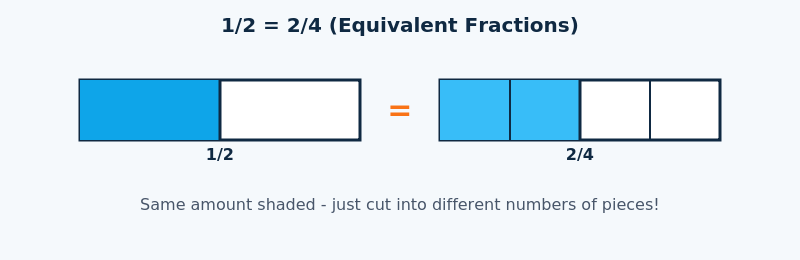
Equivalent fractions are different-looking fractions that represent the exact same amount. Like 1/2 and 2/4. Picture two pizzas the same size: one cut into 2 slices (you eat 1), and one cut into 4 slices (you eat 2). You ate the same amount of pizza both times!
To find an equivalent fraction (expanding): multiply the top and bottom by the same number.
Example 1: Find an equivalent fraction for 2/3 with a denominator of 9.
- Ask: what do I multiply 3 by to get 9? Answer: 3.
- Multiply the top by that same number too: 2 × 3 = 6.
- Answer: 6/9
To reduce a fraction to lowest terms: divide the top and bottom by the same number (their greatest common factor) until you can’t anymore.
Example 2: Reduce 8/12 to lowest terms.
- What’s the biggest number that divides evenly into both 8 and 12? That’s 4.
- 8 ÷ 4 = 2, and 12 ÷ 4 = 3.
- Answer: 2/3 (you can’t reduce it any further)
⚡Quick tip: A fraction is in “lowest terms” when the only number that divides evenly into both the top and bottom is 1.
Well you’re quick! For more practice solve lesson 17&19 from our booklet.