
Course summary field: Add, subtract, multiply, and divide fractions and mixed numbers.
Adding and subtracting fractions: the golden rule is: the denominators (bottom numbers) must match before you can add or subtract. If they match, just add or subtract the top numbers and keep the bottom the same.
Example 1: 3/8 + 2/8
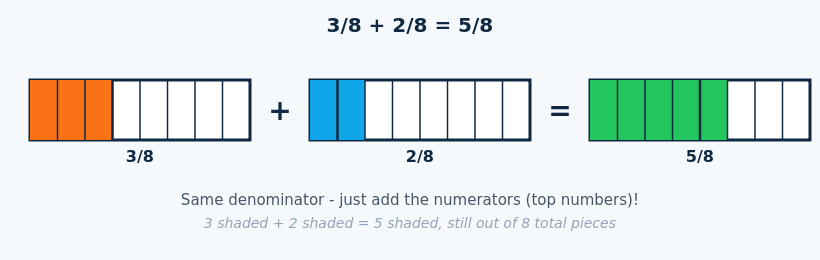
The denominators already match (both are 8), so just add the tops: 3 + 2 = 5
Answer: 5/8
Example 2: 1/3 + 1/4
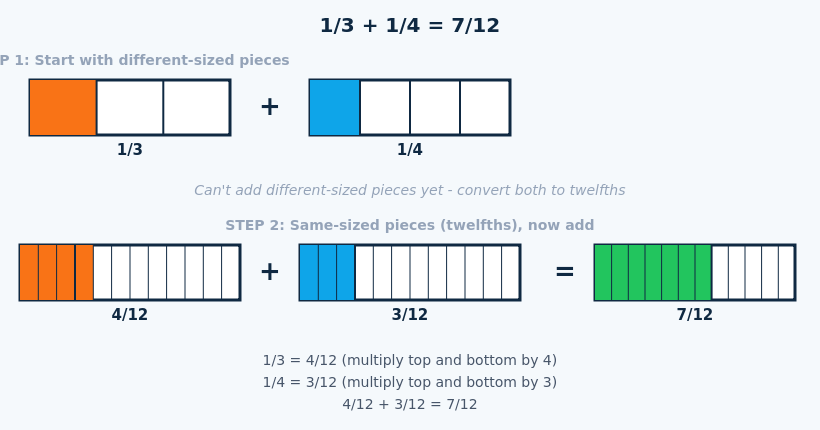
Find a common denominator: a number both 3 and 4 divide into. That’s 12.
Convert 1/3 into twelfths: multiply top and bottom by 4 → 4/12 y
Convert 1/4 into twelfths: multiply top and bottom by 3 → 3/12
Now add: 4/12 + 3/12 = 7/12
Answer: 7/12
Multiplying fractions is actually the easiest operation. You don’t need matching denominators at all! Just multiply straight across.
Example 3: 2/3 × 3/5
Multiply the tops: 2 × 3 = 6
Multiply the bottoms: 3 × 5 = 15
That gives 6/15, which reduces to 2/5
Dividing fractions uses a trick called “keep, change, flip”: keep the first fraction, change ÷ to ×, and flip the second fraction upside down.
Example 4:
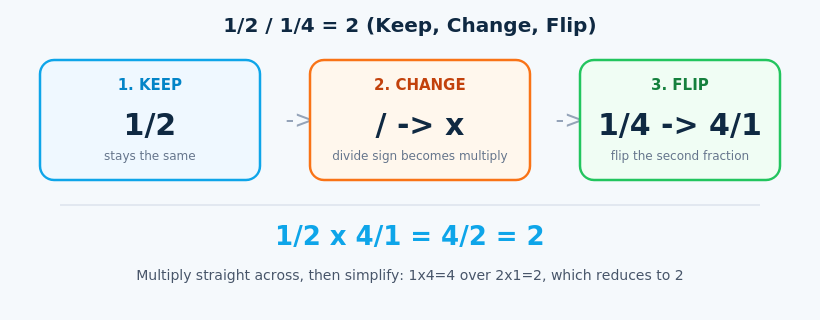
Keep: 1/2
Change ÷ to ×
Flip 1/4 to become 4/1
Now solve: 1/2 × 4/1 = 4/2 = 2
Mixed numbers (like 2 1/4) combine a whole number and a fraction. To add them, add the whole numbers together and the fractions together separately.
Example 5: 2 1/4 + 1 1/2
Convert 1/2 to quarters so the fractions match: 1/2 = 2/4
Add the whole numbers: 2 + 1 = 3
Add the fractions: 1/4 + 2/4 = 3/4 Answer: 3 3/4
That’s it! for more practice solve lesson 17,21,24,28,30 of our practice booklet