Course summary field: Understand what each digit in a big number really means, and round numbers like a pro.
Let’s talk about place value. It’s really just about where a digit sits in a number, because that tells you what it’s actually worth.
Think of a number like a team lineup: every position matters. Take the number 4,672,038. Each digit has a “job” based on its spot:
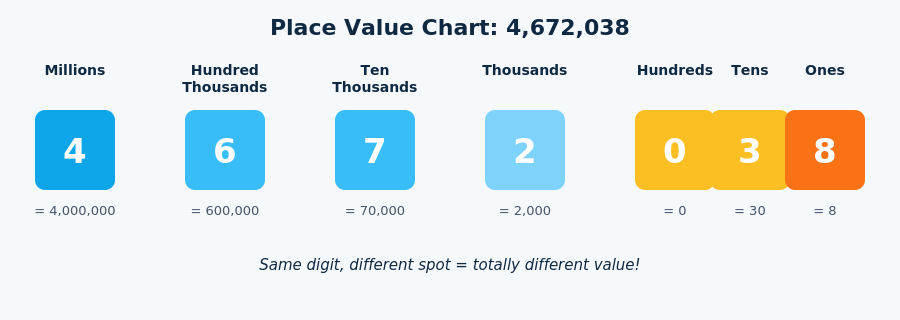
The 4 is in the millions place → it’s worth 4,000,000
The 6 is in the hundred-thousands place → it’s worth 600,000
The 7 is in the ten-thousands place → it’s worth 70,000
The 2 is in the thousands place → it’s worth 2,000
The 0 is in the hundreds place → it’s worth 0
The 3 is in the tens place → it’s worth 30
The 8 is in the ones place → it’s worth 8
Same digit, different spot, totally different value. That’s the whole idea.
Now let’s talk about rounding. Rounding means swapping a number for a “close enough” number that’s easier to work with. Like saying “it’s about 3 o’clock” instead of “it’s 2:58.”
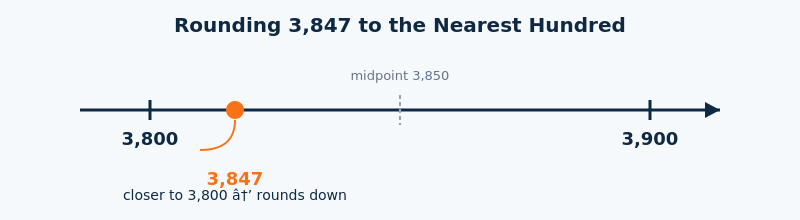
Here’s the rule: Look at the digit right after the place you’re rounding to.
- If that digit is 5 or higher, round UP.
- If it’s 4 or lower, keep the number the same (round DOWN).
Example 1: Round 3,847 to the nearest hundred.
- We’re rounding to the hundreds place, so we look at the digit right after it: the tens digit, which is 4.
- 4 is less than 5, so we round down.
- The hundreds digit (8) stays the same, and everything after it becomes 0.
- Answer: 3,800
Example 2: Round 3,847 to the nearest thousand.
- We’re rounding to the thousands place, so we check the hundreds digit: 8.
- 8 is 5 or higher, so we round UP.
- The thousands digit (3) goes up to 4, and everything after becomes 0.
- Answer: 4,000
⚡Quick tip: Rounding doesn’t erase the original number, it just gives you a simpler estimate. Estimating is super useful for checking if an answer “looks right” before you do the exact math.
woah! you leaned a whole unit just now. For more practice download our practice book, solve lesson 2 (New skills practice)