Course summary field: Long division, remainders, and dividing by two-digit numbers.
Division is the “opposite” of multiplication. Instead of putting groups together, we’re splitting a number into equal groups. 20 ÷ 4 asks: “if I split 20 into 4 equal groups, how big is each group?”
When numbers don’t divide evenly, whatever’s left over is called the remainder.
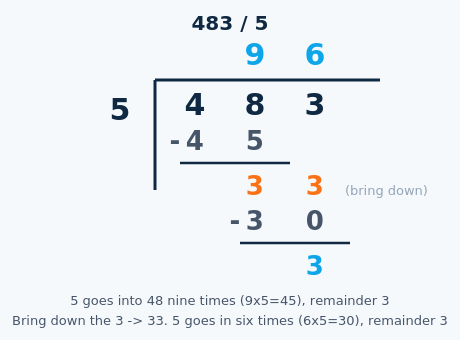
5 doesn’t go into 4 (the first digit), so look at 48.
5 goes into 48 nine times (9 × 5 = 45), with 3 left over.
Bring down the next digit (3), making 33. 5 goes into 33 six times (6 × 5 = 30), with 3 left over
Nothing left to bring down, so 3 is our final remainder.
Answer: 96 remainder 3
Dividing by a two-digit number works the same way, just with bigger estimating steps.
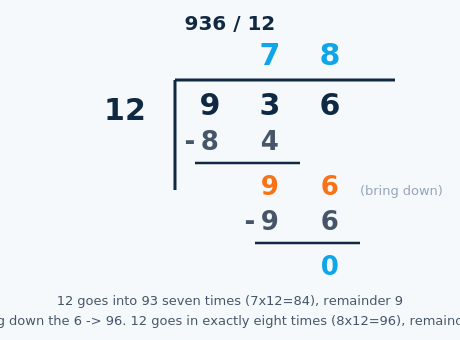
12 doesn’t go into 9, so look at 93. 12 × 7 = 84, and 12 × 8 = 96 (too big).So 12 goes into 93 seven times, with 93 − 84 = 9 left over.
Bring down the 6, making 96.
12 goes into 96 exactly 8 times (12 × 8 = 96), with 0 left over
Answer: 78
⚡Quick tip: You can always check a division answer by multiplying it back. 78 × 12 should equal 936 (it does!). If there’s a remainder, multiply first, then add the remainder back in.
Done already? That’s crazyy. For more practice solve lesson 13 & 15 from our booklet.